CHAPTER ONE: THE CHILD WHO SHOULDN’T HAVE BEEN THERE
Boston’s late-autumn wind doesn’t drift in quietly—it charges through the city like an accusation, slicing between brick buildings and sweeping across cemeteries with a bitterness that feels intentional. As I stood at Mount Auburn, facing the stone etched with my brother’s name, I understood something I’d spent years denying: grief doesn’t disappear. It waits. It waits until you believe you’ve endured it—then returns when your guard is down.
I’m Elliot Harrington. To the public, that name means influence, control, and money that moves rules without ever touching them. Harrington Global was built on calculation, not compassion. Strategy over sentiment. But none of that mattered as I stood there, hands buried in my coat, pretending this visit was routine rather than a quiet undoing.
Julian had been gone for eighteen months—killed in what police called a “single-vehicle accident” outside Providence. A neat phrase. Bloodless. Final. The case closed quickly, but something never settled. Julian lived recklessly, yes—but never blindly. Somewhere deep inside, I knew the truth had been buried alongside him.
I’d raised Julian after our parents died—me, twenty-six; him, twelve. I became his guardian, provider, employer. From the outside, it looked generous. In reality, it warped us. Dependence masquerading as care. Gratitude turning sour when it had nowhere to land.
That’s when I noticed her.
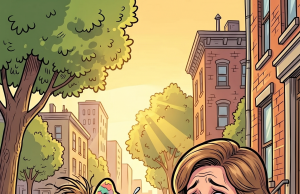
A child knelt at the base of Julian’s headstone—too small, too alone, dressed in a thin sweater against the cold. Her hands shook as she tried to push a dying carnation into the soil. The sound she made wasn’t loud—just the restrained sobbing of someone who’d learned early that crying doesn’t guarantee rescue.
“Hey,” I said softly.
She startled, but didn’t flinch. And when she looked up, my breath vanished.
Steel-blue eyes. My eyes.
For a second, I thought grief had finally cracked me.
“I’m sorry,” she said quickly, scrambling up. “I didn’t mean to make a mess.”
“You didn’t,” I replied, kneeling despite the wet earth. “I just wanted to be sure you’re okay.”
She nodded—clearly not okay—and glanced back at the stone.
“Did you know him?” she asked, holding the wilted flower like something sacred.
“He was my brother.”
Her face shifted—not relief, but fragile hope.
“Then you knew my dad.”
Time didn’t stop dramatically. It simply… paused. As if the world needed a moment to understand.
“What’s your name?” I asked.
“Mara Vale,” she said. “Mom said he couldn’t stay with us. But she said he loved me. When she got sick, I wanted to meet him. Even like this.”
I wrapped my coat around her shoulders. She leaned into it without hesitation—a trust born not of comfort, but necessity.
“Where’s your mother?”
“At home,” she said. “She sleeps a lot. I make cereal when she can’t get up. I saved my bus money today because I got first place in math, and I wanted him to know.”
Standing there, with a child my brother never told me about, I knew whatever came next would dismantle everything I believed.
Secrets don’t die.
They wait.
CHAPTER TWO: THE PLACE THE CITY IGNORED
Mara’s apartment sat in a building the city had abandoned—wedged between luxury developments and boarded storefronts. As we climbed the stairs, she counted each step under her breath—not for fun, but because routine is survival.
Her mother, Elena Vale, opened the door slowly. Pale. Frail. Afraid.
“I’m not here to take anything,” I said. “I found Mara at my brother’s grave.”
The color drained from her face.
She didn’t scream. She didn’t cry. She simply folded, as if a final support beam had snapped.
The apartment told its own story: unpaid bills, empty shelves, prescription bottles, cold air.
Julian had known.
He’d known everything.
Elena told me the truth—how Julian lived under another name, promised escape while hiding obligations, feared exposure more than responsibility.
“He said your family would destroy us,” she whispered. “That you’d take her if you knew.”
The irony burned.
What we didn’t yet know was worse.
Julian hadn’t just hidden Mara from me.
He’d hidden her from someone far more dangerous.
CHAPTER THREE: THE WOMAN WHO WROTE HISTORY
Catherine Whitmore—Julian’s legal wife—didn’t mourn quietly. She curated grief. Tailored coats. Press photos. Charitable statements.
When I showed her the DNA results, she didn’t deny them.
She smiled.
“That child was never meant for your world,” she said calmly. “And if you expose this, you’ll lose more than you gain.”
She hadn’t erased Mara by accident. She engineered it—diverted funds, intercepted letters, manipulated records. The system obeyed her.
Then the investigator found the final truth.
Julian’s crash wasn’t random.
It was designed.
CHAPTER FOUR: THE TRUTH NO ONE COULD BURY
Missing footage. Altered reports. Shell companies tied to Catherine’s trust.
Under oath, her composure collapsed.
She hadn’t killed Julian—but she’d trapped him. Debt. Threats. Silence. A choice where survival meant disappearing.
The final blow came from Mara.
Seven years old. Calm. Clear.
She spoke of her father’s promises. Of being told adults think children forget.
The courtroom didn’t breathe.
Catherine was arrested that day.
CHAPTER FIVE: WHAT I LET GO
I lost Harrington Global. My board chose distance over truth.
But I gained something worth more than any empire.
Mara stopped counting stairs.
Elena healed.
And I learned that legacy isn’t built from power—but from who speaks your name when you’re gone.
FINAL TRUTH
Power’s greatest danger isn’t corruption—it’s erasure.
Because when people believe they can make others invisible, they forget that truth always returns.
And when it does, it demands everything.