The Anchor and the Angel
“Mind if I join you?”
The rugged biker went rigid, his coffee mug frozen inches from his lips.
For nearly four long years, an unspoken wall of silence had isolated Caleb “Ash” Rourke within the walls of the Stonebridge Diner. The townspeople routinely crossed the street to avoid his path. Local law enforcement observed him from a cautious distance. Even the memories of his past seemed to hover around him like a suffocating fog. Men of Caleb’s stature were left undisturbed by sheer human instinct.
The only ambient noise in the room was the rhythmic, electric hum of the fading neon sign hanging above the counter.
Maggie, the veteran waitress, had logged enough years behind the counter to recognize a threat without a formal introduction. The man occupying the corner booth practically radiated danger. The worn leather vest. The heavy, faded patches. The undeniable one-percenter insignia stitched into his gear. This was not a patron you casually chatted with while topping off a cup.
“Excuse me, sir,” the small voice piped up a second time.
Maggie turned around—and froze in her tracks.
A little girl was positioned in a lavender wheelchair, its metallic frame personalized with an assortment of glowing star and crescent-moon stickers. Her gaze was remarkably sharp and observant, projecting a maturity that far exceeded her nine years. Standing directly behind her were her grandparents, their postures stiff with apprehension, their faces tight as if anticipating a sudden explosion.
“Sweetheart, let’s find a different spot,” Maggie intervened gently, keeping her tone soft. “You can pick any table you like.”
The child shook her head resolutely, lifting a small finger to point directly at Caleb’s booth.
“I want to sit right there.”
An absolute stillness descended upon the diner.
Slowly, Caleb raised his head. His features were heavily weathered and scarred, forged by brutal years on the open road and a single, catastrophic night that had claimed his wife—and, for a long time, silenced his voice entirely. A jagged scar sliced through his left eyebrow, trailing up into his hairline.
“Maisie,” her grandmother pleaded in an urgent, hushed whisper. “Please, let’s move.”
“I just want to share his table,” Maisie insisted with total serenity. “I have something vital to show him.”
Caleb’s jaw clenched tightly. A lone finger tapped a heavy rhythm against his porcelain mug. After a suffocating, drawn-out silence, he abruptly pushed his folded newspaper to the side and nudged his coffee out of the way.
“Sit,” he muttered gruffly.
A brilliant smile broke across Maisie’s face. She maneuvered her wheelchair forward with practiced, effortless precision, entirely unfazed. Her grandparents retreated to a distant booth, watching the interaction with the terrified expressions of parents waiting outside an intensive care unit.
Caleb observed her in absolute silence as she unclasped a sketchbook and laid the pages flat across the table.
“What do people call you?” Maisie inquired.
“Ash,” he responded.
It was the very first syllable he had uttered inside that establishment in years.
She creased her brow slightly. “That isn’t a proper name. It sounds incredibly lonely.”
He gave a slight shrug of his heavy shoulders. “That’s because it is.”
Maisie studied his scarred face, completely devoid of fear. “You aren’t frightening at all. You’re just carrying a lot of sadness. Sad people wear a tough shell so they don’t shatter into pieces. That’s what my therapist tells me.”
With a gentle slide, she pushed the illustration toward him.
The sketch depicted Caleb astride his motorcycle—but hovering directly behind him were two faint, radiant figures adorned with wings. One was unmistakably his late wife, Mara. The other was a woman Caleb had never seen before.
“I sketch you all the time,” Maisie explained softly. “You always look like a man who deeply misses someone. I miss my mom every single day, too. She passed away last year. That’s her right there. I genuinely believe they are looking out for us.”
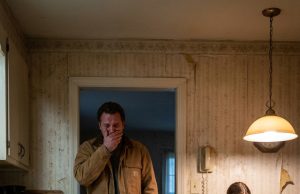
The porcelain mug shattered instantly in his grip.
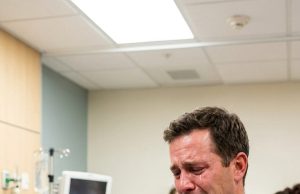
Scalding coffee flooded across the table and dripped onto the linoleum floor, but Caleb was entirely oblivious to the mess. Heavy tears sliced clean paths through the road grit on his face as a dam that had been frozen inside his chest for years finally ruptured.
The Unofficial Guardian
From that pivotal afternoon forward, the town of Brookhaven bore witness to an absolute transformation.
The notorious, feared biker seamlessly integrated into Maisie’s world. Without ever being asked, he began fixing broken structures around her grandparents’ property. He engineered a custom wooden wheelchair ramp so she could access the front porch entirely on her own. He would sit in quiet companionship beside her for hours while she sketched, the deep, guttural rumble of his chopper slowly morphing from a terrifying sound into a symbol of absolute safety.
But bureaucracy rarely tolerates unvarnished kindness.
The moment child protective services caught wind that a man with Caleb’s extensive criminal record was deeply embedded in Maisie’s daily life, the state machinery spun into motion. Legal statutes were cited. Strict protocols were implemented. Vague, malicious allegations were neatly typed onto official documentation.
A severe caseworker named Ms. Carter arrived on the scene, flanked by uniform officers and clutching a clipboard weighed down by prejudice.
“This minor is being taken into state custody immediately,” she announced coldly. “A man of your background has absolutely no business being in her proximity.”
Maisie wept hysterically as they physically removed her from the home. “You promised me! You said nobody rides alone!”
Caleb didn’t throw a punch. He didn’t scream or attempt to physically shield her. He stood entirely still and let them take her—because his instincts told him that if he reacted with violence, he would lose her to the system forever.
But he had no intention of backing down.
Later that evening, Caleb placed a single phone call.
What followed wasn’t a campaign of retaliation—it was a campaign of exposure. Powerhouse attorneys intervened. Private investigators stripped away layers of administrative secrecy. The institutional facility where Maisie had been placed was systematically exposed as a volatile, dangerous environment.
Two nights later, the facility erupted in flames.
Before the first emergency sirens could even be heard in the distance, Caleb was already on the scene. He breached the perimeter and charged directly into the billowing black smoke. He located Maisie, who was trapped in an upper-level corridor, and scooped her into his arms. With the exit cut off, he plunged through a second-story window, twisting his massive frame in midair to absorb the entire impact as they slammed into the earth.
When the fire crews finally rolled up, they encountered a striking scene: the bruised biker and the young girl were surrounded by an unshakeable perimeter of leather-jacketed riders who had mobilized—not to cause a riot—but to act as a human shield.
A New Chapter
The legal truth was vindicated shortly thereafter.
During the emergency custody hearing, the presiding judge methodically reviewed the photographic evidence of the custom porch ramp, the official first-responder reports from the structural fire, and Maisie’s latest illustration—which now depicted a burly biker flanked by majestic angel wings.
The judge looked over his glasses at the prosecution. “A menace to society? Absolutely not. This man is a guardian angel.”
Maisie was permanently returned to the care of her grandparents. But in the process, she inherited a brotherhood far vaster than she could have ever dreamed possible.
Now, every single weekend, the prime corner booth at the Stonebridge Diner is permanently marked as taken. A smiling little girl in a lavender wheelchair happily eats her breakfast beside a heavily scarred biker.
And out on the curb, a long line of motorcycles stands guard along the pavement.
The town of Brookhaven had finally absorbed a fundamental truth about human connection:
True family has nothing to do with a shared bloodline.
It’s defined by the people who are willing to run straight into the fire to bring you home.