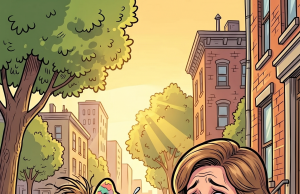
The sun was sinking behind the empty highway in Jalisco, washing the sky in scorched shades of orange that might have looked beautiful on any other day.
But for eight-year-old Diego, that sunset marked the moment his childhood shattered.
Dark smoke curled from the crumpled engine of an old Nissan Tsuru, overturned in a roadside ditch. Shards of glass sparkled across the pavement like cold, indifferent stars—silent proof of the crash that had stopped his world.
“Mom! Mom, please wake up!” Diego cried, his voice hoarse with terror. His small hands trembled as he shook Camila, her head slumped unnaturally against the steering wheel, a thin line of blood slipping down her temple.
Several meters away, a black Mercedes screeched to a halt.
Santiago Delgado stepped out, a man accustomed to pressure, power, and control. His Italian suit was immaculate, his expression guarded. Years in corporate warfare had trained his instincts well: Call emergency services and leave. Don’t get involved.
He was late. A critical meeting awaited him in León, one that could determine the survival of his company amid a brewing financial scandal. His life was already in chaos. He didn’t need someone else’s tragedy added to it.
Then he saw the boy.
Diego was trying to wipe blood from his mother’s face with the sleeve of her worn school sweater. Something inside Santiago cracked. The emotional armor he’d spent ten years building fractured in an instant.
He ran.
Ignoring the dust that ruined his shoes, Santiago reached the wreck. “Are you hurt?” he called out, already knowing the answer. Camila was barely conscious, pinned by twisted metal, struggling for breath.
“My mom won’t wake up,” Diego sobbed, gripping Santiago’s leg like a lifeline. “Please tell me she won’t die. My dad already died. I don’t want to be alone.”
The words struck Santiago with brutal force.
He knelt in the dirt, stained his trousers with oil and dust, and checked Camila’s pulse—weak, but present.
“She’s strong,” he said gently. “She’s going to make it. Help is coming.”
He didn’t leave them.
By the time the ambulance arrived—twenty agonizing minutes later—Santiago had torn off his silk shirt to press against Camila’s wound. One of the paramedics froze when he saw her.
“My God… it’s Camila Herrera.”
“You know her?” Santiago asked.
The man nodded. “Sir, this woman saved my daughter from a kidnapping three years ago. She stepped in front of armed men without hesitation. She works in forgotten neighborhoods, bringing food, medicine, hope. If the world had more people like her, it would be a better place.”
Santiago looked at Camila again—not as a hero, but as a tired mother in worn clothes. Then he looked at Diego, clinging to her hand as if it were the only thing holding the universe together.
“I’m coming with you,” Santiago said suddenly.
He canceled his meetings. Silenced his phone—ignoring calls from partners and from Isabela, the wife he shared a mansion with but not a marriage.
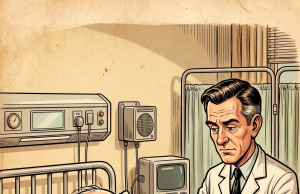
At the hospital, time stretched endlessly. Santiago—used to commanding boardrooms—sat powerless in a public waiting room, drinking bitter vending-machine coffee while listening to Diego talk about dinosaurs to keep from crying.
The boy told him about their small apartment, the nights without gas, the debts his mother worried about when she thought he was asleep.
Two days later, Camila woke to find a stranger asleep in a plastic chair beside her bed—and her son playing with brand-new toy robots.
“Who are you?” she asked weakly.
Santiago explained everything, leaving out the part about wealth and collapse. He said he’d just been passing by.
Reality hit again at discharge. Camila couldn’t walk. Therapy would take weeks. Her apartment was on the third floor. No elevator. No money.
“Come stay at my place,” Santiago said, surprising even himself.
Camila resisted. “We barely know you.”
“I have a guest house. Separate. A pool for therapy,” he insisted. “Consider it… fate paying forward.”
He lied. No one had ever helped him. And maybe that was why he needed to help now.
Life at the mansion changed them all.
For Diego, it was a dream.
For Camila, gratitude mixed with discomfort.
For Santiago, it was awakening.
He came home early. Skipped work. Helped Camila in the pool, holding her steady as she relearned strength. He listened to her stories—families surviving with nothing, dignity in poverty. His business problems began to feel absurd.
“Why are you doing this?” Camila asked one night.
“Because I’ve never seen my money create real happiness,” Santiago admitted. “You brought life back into mine.”
Hope returned—dangerously.
Then reality arrived in a red convertible.
Isabela stepped out, elegant and merciless.
“So,” she said sweetly, “you’ve turned our home into a charity shelter?”
Her presence poisoned the air. What followed was psychological warfare—insults, humiliation, cruelty aimed at Camila and Diego.
Camila tried to leave.
“I’ll divorce her,” Santiago promised.
Isabela struck first.
A photographer. A stolen moment. A photo twisted into scandal.
The headlines were brutal.
Diego cried.
Camila packed and left.
Santiago was given a choice: destroy Camila publicly or lose everything.
He chose truth.
At a press conference, he resigned. Gave up his empire. Created the Diego Foundation.
The world called him insane.
Three months later, Camila stood at a community center opening.
A bus stopped.
Santiago stepped off—jeans, sneakers, sunflowers in hand.
No mansion. No fortune. Just purpose.
He knelt.
“Will you let me build a real life with you?”
Diego answered first.
Camila followed.
Years later, the foundation changed thousands of lives.
And sometimes, driving home in an old car, Santiago remembered the accident.
The day he lost everything.
And gained what mattered most.